
Best Jobs for Highly Sensitive People: finding fulfillement and joy
Updated on March 31, 2026
Highly sensitive people can feel overwhelmed trying to find the best jobs for them.
As someone deeply attuned to emotions, environments, and subtle nuances, the question is often not only what you can do, but what kind of work will truly fit who you are.
Many people searching for jobs for highly sensitive people, highly sensitive person careers, or highly sensitive person jobs are not only looking for a list of professions.
They are trying to understand why work feels draining, why some environments feel too much, and how to find a path that feels more aligned.
This article explores career paths that may suit highly sensitive people, why self-awareness matters so much in career choices, and how to find work that feels sustainable, meaningful, and emotionally healthier.

Why Career Choices Matter for Highly Sensitive People
Highly sensitive people often feel deeply connected to their work.
For many HSPs, a job is not only a source of income. It is also a reflection of their values, their nervous system needs, and their sense of purpose.
This is one reason why traditional high-pressure environments can feel so difficult. Constant noise, multitasking, conflict, lack of autonomy, or work that feels disconnected from personal meaning can slowly create emotional overload.
When the work environment is more supportive, highly sensitive people often thrive.
Their empathy, creativity, perceptiveness, depth of processing, and ability to notice subtle details become strengths.
So the search for the best jobs for highly sensitive people is not only about choosing from a list.
It is about understanding yourself well enough to choose a path that respects your sensitivity instead of fighting against it.

What Makes a Job a Good Fit for a Highly Sensitive Person
Not all highly sensitive people are the same.
There is no single perfect profession for every HSP.
Still, many jobs for sensitive people tend to feel more sustainable when they include some of these qualities:
A calmer environment with less overstimulation
Work that feels meaningful
Autonomy and personal responsibility
Time for deep focus
Healthier boundaries
A pace that allows recovery
A role that feels aligned with personal values
When people look for jobs for HSP or highly sensitive person careers, they are often trying to find these conditions, even if they do not yet have the words for it.

My Personal Journey
Sharing a bit about my own story may help you see this more clearly.
I am a highly sensitive person too. I started my career as a mechanical engineer and worked for fifteen years in the automotive and motorcycle industry. Motorcycles and speed were lifelong passions of mine, and my logical, problem-solving mind led me to study engineering and build a career in that field.
On paper, it looked like the right path. I could easily have imagined growing older and retiring in that environment.
But over time, I understood something important. Engineering was a passion, but it was not my deeper mission. There was a persistent sense that something essential was missing. My true calling was in helping people (infact I did teaching, lifeguard, swiming coach in my university time, all jobs that somehow help people and make me feel at my place)
So I started again. I went back to school and trained to become a therapist. Today, since over 10 yars, I help sensitive people find more balance, understand their inner experience more clearly, heal from the weight of past experiences, and reconnect with who they are.
My own journey taught me that highly sensitive person jobs are not the ones that look the most impressive or exciting from the outside. They are about finding work that fits both your strengths and your truth.

The Best Jobs for Highly Sensitive People
While highly sensitive people can succeed in many different professions, some career paths often feel more natural because they allow depth, meaning, creativity, or stronger control over the environment.
Therapeutic and Caring Professions
Many highly sensitive people feel drawn to counseling, psychotherapy, coaching, or holistic healing. These roles make space for empathy, listening, and emotional depth. Supporting others in a meaningful way can feel deeply fulfilling.
Teaching and Education
Highly sensitive people often make thoughtful educators because they tend to notice individual needs and adapt their approach with care. Whether teaching children, teenagers, or adults, they often create a more human and connected learning environment.
Artistic and Creative Fields
Writing, painting, photography, music, illustration, design, and other creative paths allow highly sensitive people to process emotions and ideas through expression. These roles often offer flexibility and depth, which many HSPs need.
systeme.io
Entrepreneurship and Freelancing
For many HSPs, autonomy changes everything. Working independently allows more control over schedule, rhythm, boundaries, and environment. This is one reason why jobs for highly sensitive people often include freelance or self-employed paths.
Research, Analysis, and Deep Work Roles
Some highly sensitive people thrive in roles that require concentration, reflection, and attention to detail. Research, editing, analysis, strategy, and writing can be a strong fit when the environment is calm enough.
Helping Professions with Structure
Not every HSP wants a fully creative or therapeutic path. Some feel better in structured roles where they can still contribute with care and intelligence. A highly sensitive person career may also include fields such as project coordination, user research, academic work, translation, or design.

Jobs That Often Drain Highly Sensitive People
This does not mean there are “forbidden” jobs for HSPs. Highly sensitive people can succeed in many demanding fields.
Still, some work environments tend to create more strain, especially when there is constant pressure with no room for recovery.
Examples may include:
High-conflict workplaces
Jobs with constant interruptions
Roles with aggressive sales pressure
Environments with noise, chaos, or little autonomy
Work cultures where emotional awareness is dismissed
This is why the conversation around jobs for sensitive people should not focus only on job titles. The work environment matters just as much as the profession itself.
For more about this subject you can also check my article:

Breaking the Stereotypes
It is easy to assume that highly sensitive people can only do quiet, soft, or “safe” jobs.
That is not true.
High sensitivity is not a weakness.
It is not a sign that a person is fragile or incapable.
It is a trait that affects how information, emotions, and stimulation are processed. With enough self-awareness and the right support, highly sensitive people can become excellent scientists, lawyers, leaders, entrepreneurs, therapists, teachers, artists, and strategists.
What matters most is not choosing a path based on stereotypes. What matters is choosing a path that feels aligned, manageable, and meaningful for your particular system.
If you are considering a career change, do not let external expectations define what is possible for you.
Some highly sensitive person jobs will look traditional. Others will look unconventional.
The important question is whether the path fits you.

Why Highly Sensitive People Often Feel Misaligned at Work
Many highly sensitive people are competent, responsible, and hard-working. From the outside, their career may even look successful.
And yet, something can still feel off.
Sometimes the real issue is not lack of ability. It is a deeper mismatch between identity, values, nervous system needs, and daily work reality.
A person may be good at a job and still feel emotionally depleted by it. They may be high-performing and still feel disconnected. They may stay because they are responsible, loyal, or afraid of disappointing others.
This is one reason why so many searches around highly sensitive person careers are not only about professional success.
They are also about relief, stability, and permission to live differently.

How to Find the Best Job for You as a Highly Sensitive Person
Choosing the best job as a highly sensitive person is not about following a rigid checklist.
It is about understanding what helps you function well and what slowly wears you down.
Reflect on Your Strengths
What comes naturally to you. Listening, observing, creating, organizing, analyzing, guiding, writing. Your strongest career clues often live there.
For more about this subject you can also check my article:
Pay Attention to Joy
When do you feel most alive, focused, or quietly fulfilled. Many HSPs find that meaningful work feels different in the body. There is effort, but not the same kind of internal friction.
Notice What Drains You
Pay attention to overstimulation, emotional exhaustion, constant urgency, lack of control, or environments where you keep adapting while losing yourself.
Set Boundaries Around the Way You Work
For many HSPs, the issue is not only the job itself. It is also workload, schedule, recovery time, and emotional boundaries.
For more about this subject you can also check my article:
Be Courageous
Sometimes the right path asks you to leave something familiar. That can be hard. But staying too long in a role that repeatedly disconnects you from yourself also has a cost.
For more about this subject you can also check my article "Sensitive professional at work"

A Message of Encouragement
You do not have to fit into someone else’s model of success.
Whether you are drawn to caregiving, education, art, strategy, entrepreneurship, or a path that makes sense only to you, the most important thing is to honour who you are.
Your sensitivity is not the problem. In the right conditions, it becomes a source of depth, insight, creativity, and connection.
The best jobs for highly sensitive people are not the ones that look good from the outside. They are the ones that respect the truth of the person living them.

Support for Highly Sensitive Professionals Who Feel Stuck
Some people searching for jobs for highly sensitive people are not only looking for career ideas. They are trying to understand why their current work leaves them anxious, depleted, numb, or disconnected from themselves.
If you feel stuck between responsibility, ambition, sensitivity, and emotional overload, therapeutic support may help you understand what is happening more deeply.
In my work, I support highly sensitive people who want to feel more stable, more aligned, and more themselves.
This may involve exploring old patterns, emotional overload, over-adaptation, self-doubt, or the gap between outer success and inner truth.
Watch the Full Video
For more reflections on this topic, you can also watch my YouTube video about jobs for highly sensitive people and career alignment.
Frequently Asked Questions About Jobs for Highly Sensitive People
The best jobs for highly sensitive people are usually roles that allow meaning, autonomy, depth, and a healthier level of stimulation. Examples include teaching, therapy, writing, design, research, and some forms of self-employment.
Jobs for HSP often work better when the environment is calm, the pace is manageable, and the role feels aligned with personal values. The right fit depends on the person, not only on the job title.
Yes. Many highly sensitive people succeed in demanding careers. The key issue is not whether a role is prestigious or difficult, but whether the environment is supportive enough and whether the work fits the person.
Many highly sensitive people struggle at work because of overstimulation, emotional tension, lack of boundaries, constant urgency, or a deeper mismatch between identity and role.
Yes. Freelancing, self-employment, creative work, consulting, therapy, writing, teaching, and remote knowledge work are often explored by sensitive people who need more flexibility and autonomy.

Simona D'Isanto
Author
Hi, and welcome to my blog!
Here, I share insights and resources to support your emotional well-being and personal growth.
I also offer individual and group sessions in psychotherapy, coaching, and sophrology — tailored especially for Highly Sensitive People (HSPs).
I’m here to support you in English, French, or Italian. Feel free to explore the website in the language that feels most comfortable for you.
👉 Click here to discover how we can work together
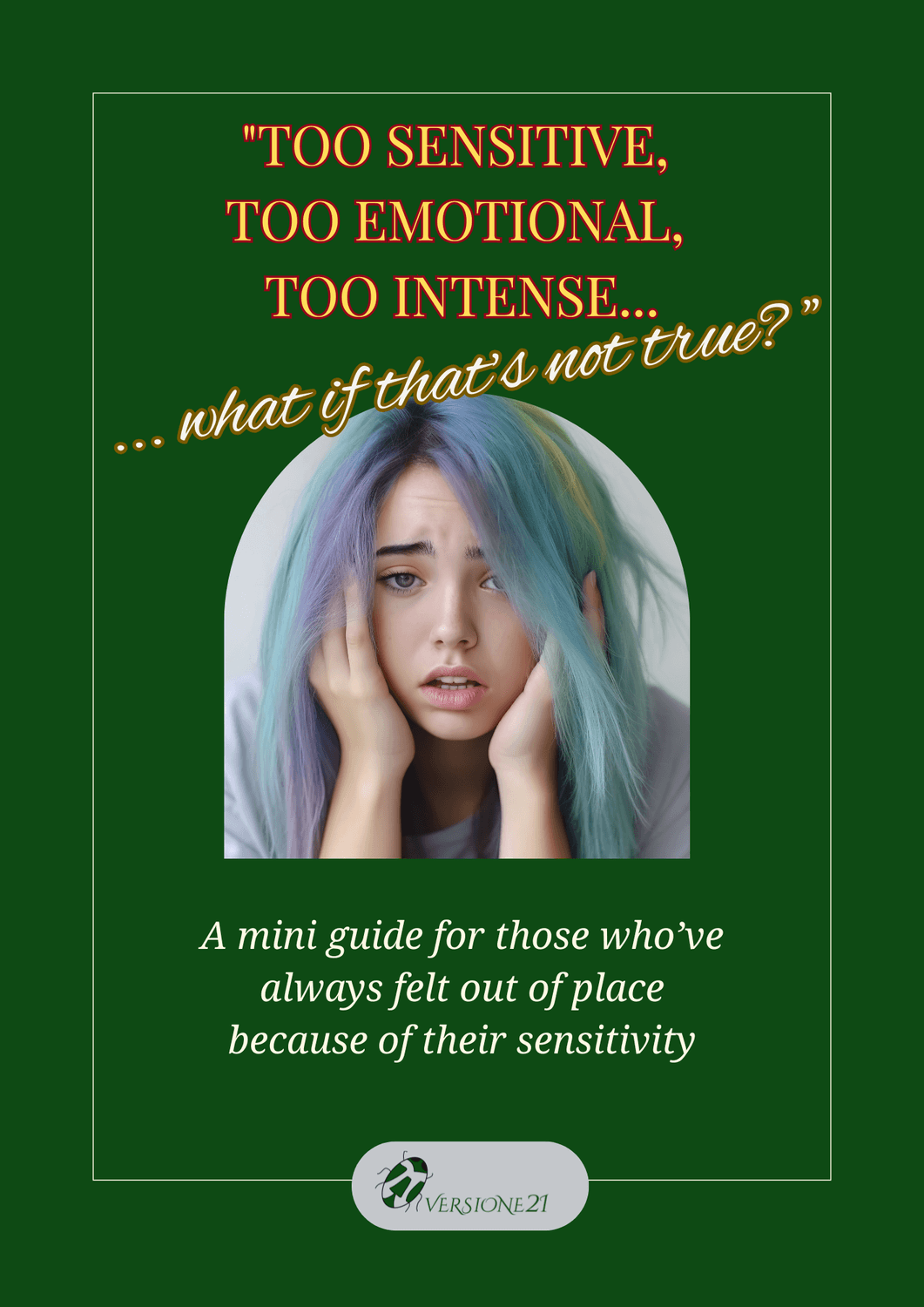
👉 Click here to download my new free guide for Highly Sensitive People :
👉 Click here to buy my journal for Highly Sensitive People :
Follow me


© 2026 Versione21 . ALL RIGHTS RESERVED.
Simona D'Isanto SIRET : 839 889 995 00016
"Conformément aux articles L.616-1 et R.616-1
du code de la consommation, notre société a mis en place un dispositif de médiation de la consommation. L'entité de médiation retenue est :
MEDIATION CONSOMMATION DÉVELOPPEMENT/MED CONSO DEV
En cas de litige, vous pouvez déposer votre réclamation sur son site : https://www.medconsodev.eu
ou par voie postale en écrivant à :
MEDIATION CONSOMMATION DÉVELOPPEMENT/MED CONSO DEV
Centre d’Affaires Stéphanois SAS
IMMEUBLE L’HORIZON – ESPLANADE DE FRANCE
3, RUE J. CONSTANT MILLERET – 42000 SAINT-ÉTIENNE"