
8 Signs You Are a Highly Sensitive Person
Updated on February 15, 2026
In equal measure, it is estimated that highly sensitive people make up around 20% of the worldwide population, men and women.
High sensitivity is not a defect or disease but simply a trait like hair colour, left-handedness or having freckles. Most people analyse information using the left-brain hemisphere, while highly sensitive people mainly use the right hemisphere.
That is why highly sensitive people are interested in other topics, think differently, and deal meticulously with their collected information. But unfortunately, this requires an extra effort to process all the information and often adds a degree of difficulty in decision-making.
Each highly sensitive person has different degrees of sensitivity and develops multifaceted characteristics with personal paths and experiences.
However, there are common traits for highly sensitive people.
Here are some of them:
Overthinking
Their extremely detailed mental analysis gets them a much wider amount of data to be processed, so they need a greater reflection upon what happens and surrounds them. This constant overthinking, if not guided, complicates or blocks a healthy analysis process. It can lead to difficulties in decision-making, low self-esteem, eating or sleeping disorders, anxiety, panic attacks, problems in personal and professional relationships etc.
The sensitivity of the 5 senses
Their senses are often more potent, and they perceive subtle nuances that escape others. They can, therefore, feel disturbed by sounds that are too loud, solid flavours or smells, and artificial lights.

Feeling odd or different
Having their way of processing information, they certainly have their vision of what happens around them and a different reaction. Depending on education, culture and the family environment, since childhood, they often receive comments such as: "You are too sensitive!", "You think too much" or "How can you think like that?" or "How could you think about it?" etc. All this increases the sense of diversity and inadequacy and, in some cases, can make them feel misunderstood, alone, and null.
Deep emotions
They get overwhelmed in front of a movie or an emotional situation (romantic, painful, stressful). They tend to have "easy tears" or feel easily overwhelmed by what they live internally.
Strong sense of honesty, justice, and extremely high standard
An overly sensitive friend, colleague or employee is invaluable because you can always count on his sense of justice and honesty as well as their self-imposed high standards. However, they demand the same from the people around them; so, when the expectations are disregarded, they live a profound disillusionment, loss of esteem, and misunderstanding.
Empathy
They can tune into the emotions of people around them, even if they are strangers, and perceive how they feel. However, if they do not learn to remain grounded and listen to themselves, they can get confused and cannot tell the difference between their emotions and the one of the others.

Need for silence and solitude
The need for regular silence or some time in solitude to recharge: Especially after spending time in groups or with difficult or negative people. Their sensitivity leads them to "quickly load up too much data", silence and loneliness are often their quickest way of "cleaning up what doesn't belong to them," like a computer clearing the contents of the cache or trash.
The others come first
Being available to help others, often forgetting one's well-being: Their empathetic ability and emotional experiences lead them to put themselves in the other's shoes and try so hard to avoid hurting other people. As a result, they tend to help anyone who may need physical help, emotional support or listening, often failing to set boundaries or clarify their needs or desires in the professional and personal spheres.

An example at work: They often tend to offer their help to colleagues in difficulty to the point of regularly overworking.
An example in personal life: Sometimes sensitive girls struggle to clarify that they are not involved in someone courting them. Girls believe they have been straightforward, but the need to be kind and not cause pain leads them to send contradictory signals and find themselves pursued by in-love guys who think they have a chance.
These are just some of the common signs of sensitive people. Several books speak extensively of the various facets of highly sensitive people, and several psycho tests can help identify them. However, the psycho test from Elaine N. Aron in her most famous book "Highly Sensitive People" is still one of the best and most exhaustive, although she says: "no psychological test is accurate".
For more suggestions about reading on this subject, click here.
and if you like to read more about this trait I suggest you to start from my article about the streinghts of high sensitivity
I wrote a free guide for highly sensitive people you can down load it here: " Too sensitive, too emotional, too intense"
FQA
Being HIGHLY SENSITIVE means having a nervous system that is more reactive to internal and external stimuli.
It is a personality trait, not an illness, and it concerns the way you experience emotions, relationships, and sensory input.
Research shows that between 15 percent and 30 percent of the population has traits of high sensitivity. It is therefore a common characteristic, found in men and women of all ages.
Common signs include deep empathy, strong reactivity to noise, light, or smells, a need for solitude after intense experiences, deep thinking, and a strong sense of responsibility.
No, they are not the same.
High sensitivity is a stable trait present from birth. Anxiety and depression are clinical conditions that can also appear in people who are not sensitive.
Being highly sensitive increases vulnerability, but it does not mean being ill.
Yes, there are questionnaires such as the HSPS, Highly Sensitive Person Scale, developed by psychologist Elaine Aron. These tools provide an indication, but they do not replace a conversation with a qualified professional.
Managing high sensitivity starts with understanding your nervous system and learning to regulate it.
Simple practices help a lot.
Create moments of silence during the day to reduce overstimulation.
Set clear boundaries to protect your energy, especially in work and relationships.
Limit exposure to loud environments, intense social interactions or constant digital input.
Develop body-based practices such as breathing, grounding or gentle movement to calm your system.
Write or reflect regularly to process emotions instead of keeping everything inside.
For many highly sensitive people, support through therapy or coaching is also helpful.
A structured approach helps reduce overthinking, emotional overwhelm and chronic stress, and allows sensitivity to become a stable strength instead of a daily struggle.
Not always.
Being highly sensitive is not a disorder.
Therapy becomes helpful when sensitivity feels like a burden, leads to suffering, or interferes with daily life.
In such cases, a humanistic approach such as the person centered therapy developed by Carl Rogers is especially appropriate.
Often, highly sensitive people did not receive the support they needed during childhood or have gone through difficult experiences that left emotional wounds. In therapy, these wounds can be processed in a safe space so that sensitivity becomes a strength again.
Join my VIP individual program for Highly sensitive people and Empaths
Photo by Zac Durant on Unsplash
Photo by Tom Pumford on Unsplash
Photo by Johannes Krupinski on Unsplash

Simona D'Isanto
Author
Hi, and welcome to my blog!
Here, I share insights and resources to support your emotional well-being and personal growth.
I also offer individual and group sessions in psychotherapy, coaching, and sophrology — tailored especially for Highly Sensitive People (HSPs).
I’m here to support you in English, French, or Italian. Feel free to explore the website in the language that feels most comfortable for you.
👉 Click here to discover how we can work together
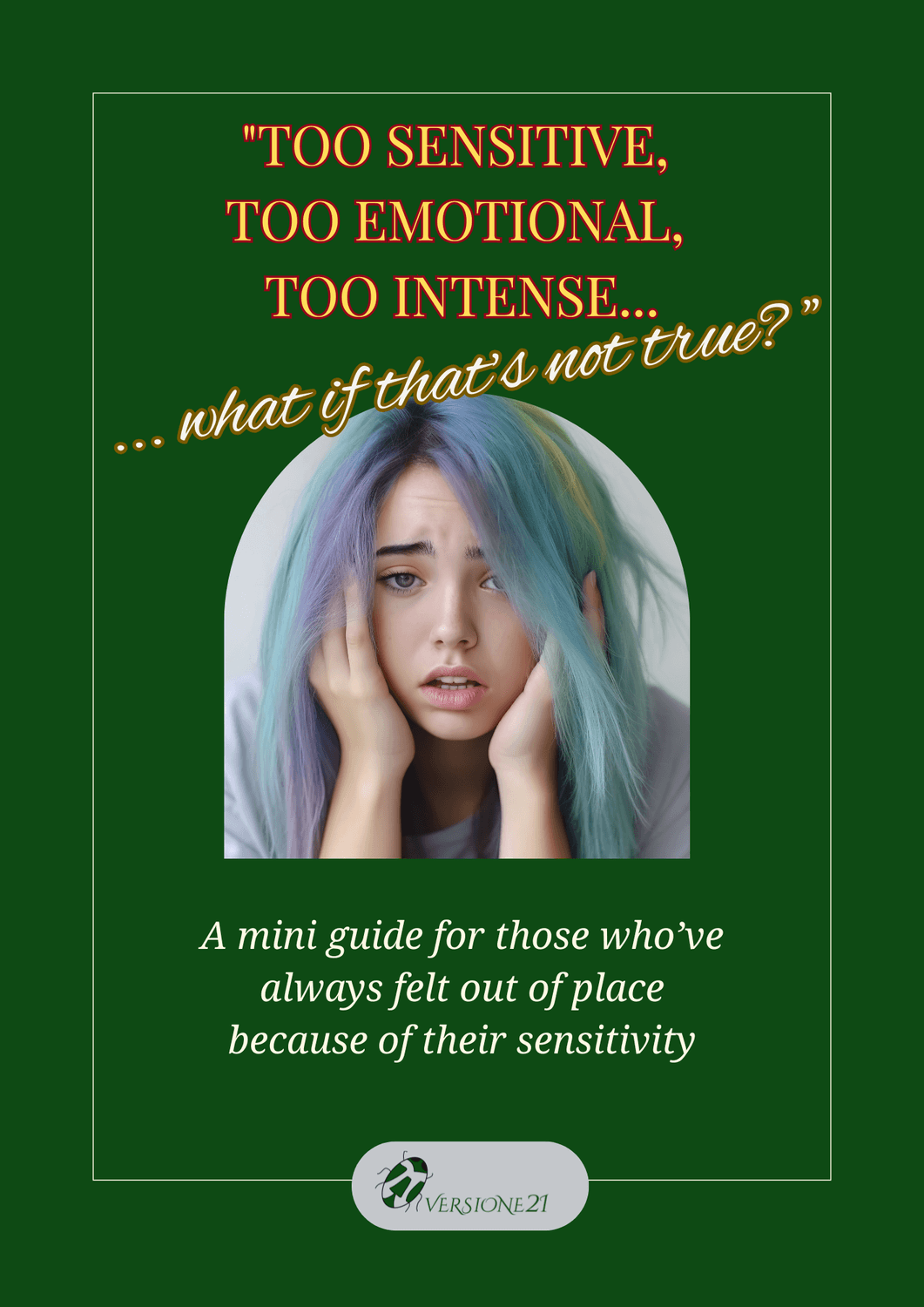
👉 Click here to download my new free guide for Highly Sensitive People :
👉 Click here to buy my journal for Highly Sensitive People :
Follow me


© 2026 Versione21 . ALL RIGHTS RESERVED.
Simona D'Isanto SIRET : 839 889 995 00016
"Conformément aux articles L.616-1 et R.616-1
du code de la consommation, notre société a mis en place un dispositif de médiation de la consommation. L'entité de médiation retenue est :
MEDIATION CONSOMMATION DÉVELOPPEMENT/MED CONSO DEV
En cas de litige, vous pouvez déposer votre réclamation sur son site : https://www.medconsodev.eu
ou par voie postale en écrivant à :
MEDIATION CONSOMMATION DÉVELOPPEMENT/MED CONSO DEV
Centre d’Affaires Stéphanois SAS
IMMEUBLE L’HORIZON – ESPLANADE DE FRANCE
3, RUE J. CONSTANT MILLERET – 42000 SAINT-ÉTIENNE"